
…Accord presidential candidate Says Nigeria Can Be One Nation Without Losing Its Cultural Identities
Accord Party presidential candidate, Dr. Gbenga Olawepo-Hashim, has called for a broader approach to national unity, saying Nigerians can build one nation without having to abandon their different cultural identities.
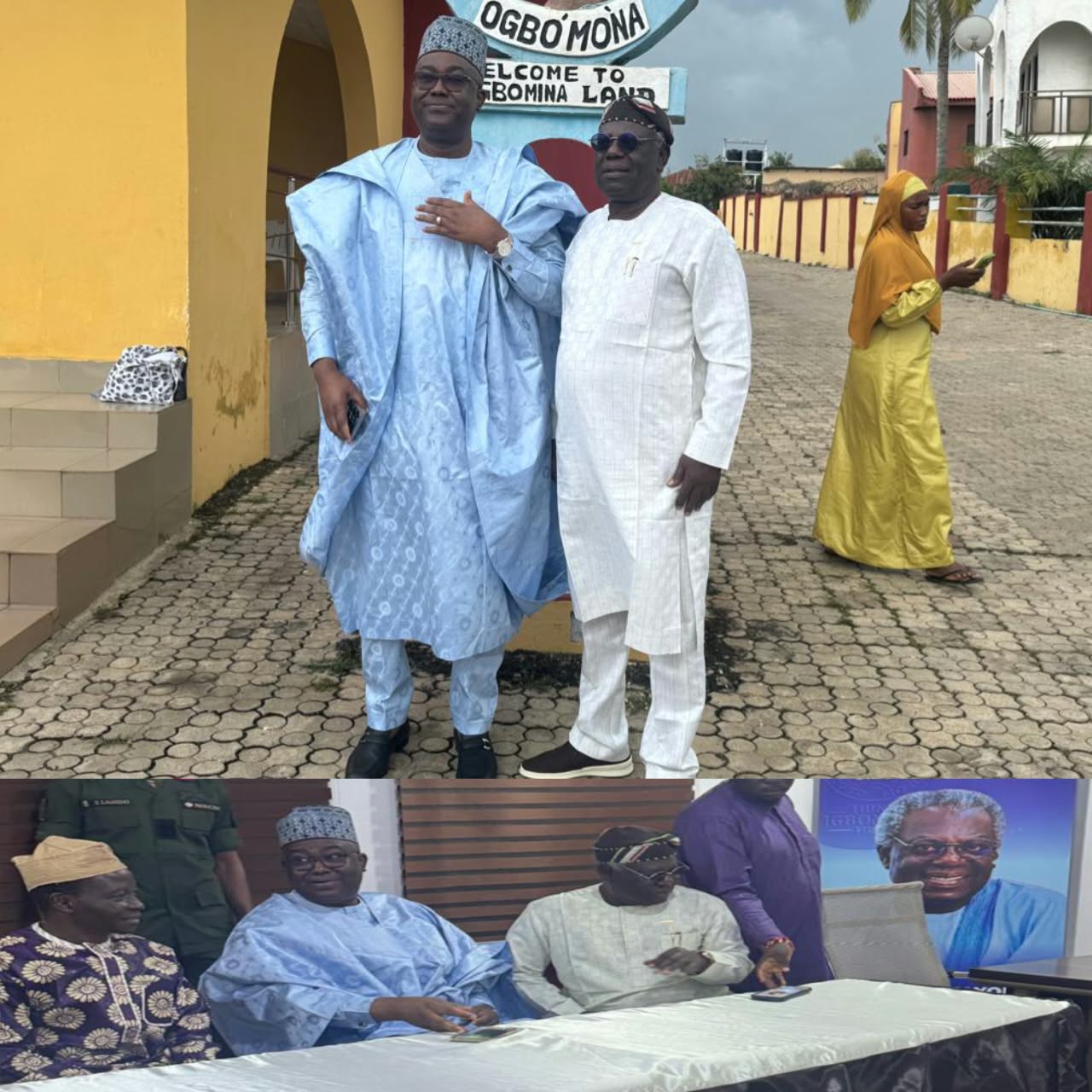
Hashim made the observation on September 29, 2026, during a courtesy visit to the Omo Ibile Igbomina House in Ganmo, Kwara State, where he was received by the organisation’s National President, Sir Bisi Fakayode.

The visit brought together discussions on the development of the Igbomina institution, the longstanding relationship between Hashim and Fakayode, and the wider challenge of building a united Nigeria despite its cultural and ethnic diversity.
Fakayode took the Accord presidential candidate on a tour of the Igbomina House, showcasing renovation and rehabilitation projects carried out under his leadership.
He also led Hashim through the adjoining hospitality facility and other sections of the complex where development work is still ongoing.
Fakayode used the occasion to acknowledge Hashim’s longstanding support and encouragement, describing him as a friend, supporter and valued stakeholder in the affairs of the Igbomina people.
According to him, Hashim was among the first three prominent supporters of the present Omo Ibile Igbomina leadership during its formative period.
“What we are witnessing today did not start today. You supported and encouraged this journey from the beginning. From my days as a local government chairman to where God has brought me today as the national president of Omo Ibile Igbomina, your support and encouragement have been part of this journey,” Fakayode said.
Fakayode also noted that although Hashim’s ancestral roots are outside present-day Kwara State, his upbringing and longstanding association with Igbomina have created a strong personal bond between him and the people.
Responding, Hashim commended Fakayode for the transformation taking place at the Igbomina House and expressed appreciation for the opportunity to inspect the projects himself.
He acknowledged the progress recorded under Fakayode’s leadership and encouraged the Omo Ibile Igbomina leadership to sustain its efforts towards strengthening the institution and advancing the interests of Igbomina people.
Hashim also reflected on Fakayode’s journey from public service and local government leadership to his present position as national president of the organisation.
For Hashim, however, the visit was about more than the physical development of the Igbomina House or his longstanding relationship with Fakayode.
He said his connection with Igbomina is deeply personal.
Hashim explained that although his ancestral roots are in Yauri, he was raised within an Igbomina family that lived in New Bussa, Niger State.
He said that experience shaped his understanding of community, identity and belonging from an early age.
According to the Accord candidate, growing up in that environment exposed him to what he described as Igbomina’s longstanding tradition of cultural accommodation and peaceful coexistence.
He recalled that Igbomina communities have historically existed alongside people from different ethnic backgrounds, including Fulani, Hausa, Tiv, Zuru, Birom and Igala communities.
Hashim said these groups were not simply treated as outsiders but became part of the wider social, economic and political life of their host communities while maintaining their individual identities.
He argued that such an experience demonstrates that cultural diversity does not automatically have to produce division.
Hashim described the environment in which he grew up as an example of what he called the “workability, resilience and strength of cultural pluralism.”
He said people from different backgrounds can live together, trade, farm, build relationships and participate in shared social and political activities without giving up their individual identities.
“We don’t have to become identical to become one nation. We can be different and yet belong together,” Hashim said.
The Accord presidential candidate argued that Nigeria’s diversity can become a source of strength when it is supported by mutual respect, effective institutions and a shared sense of belonging.
He said the lesson from his Igbomina experience is that national unity should not be confused with cultural uniformity.
Rather, he suggested that Nigerians can retain their different identities while working within institutions that promote common interests and equal belonging.
Hashim described his visit to the Omo Ibile Igbomina House as more than a social engagement.
He called it “a reminiscence of where I came from, a celebration of what I have experienced, and an inspiration for what Nigeria can still become.”
The Accord candidate maintained that Nigeria’s numerous ethnic and cultural identities should not necessarily be viewed as a weakness.
He argued that when diversity is properly organised, mutually respected and protected by strong institutions, it can contribute to national cohesion rather than undermine it.
Hashim’s message was therefore centred on the possibility of building a shared Nigerian identity without erasing the cultural identities that make up the country.
For him, the experience of Igbomina offers one example of how people with different backgrounds can live and prosper together while preserving who they are.
The visit ended with renewed emphasis on the relationship between Hashim and the Omo Ibile Igbomina leadership, as well as continued efforts to develop the organisation’s facilities in Ganmo, Kwara State.