
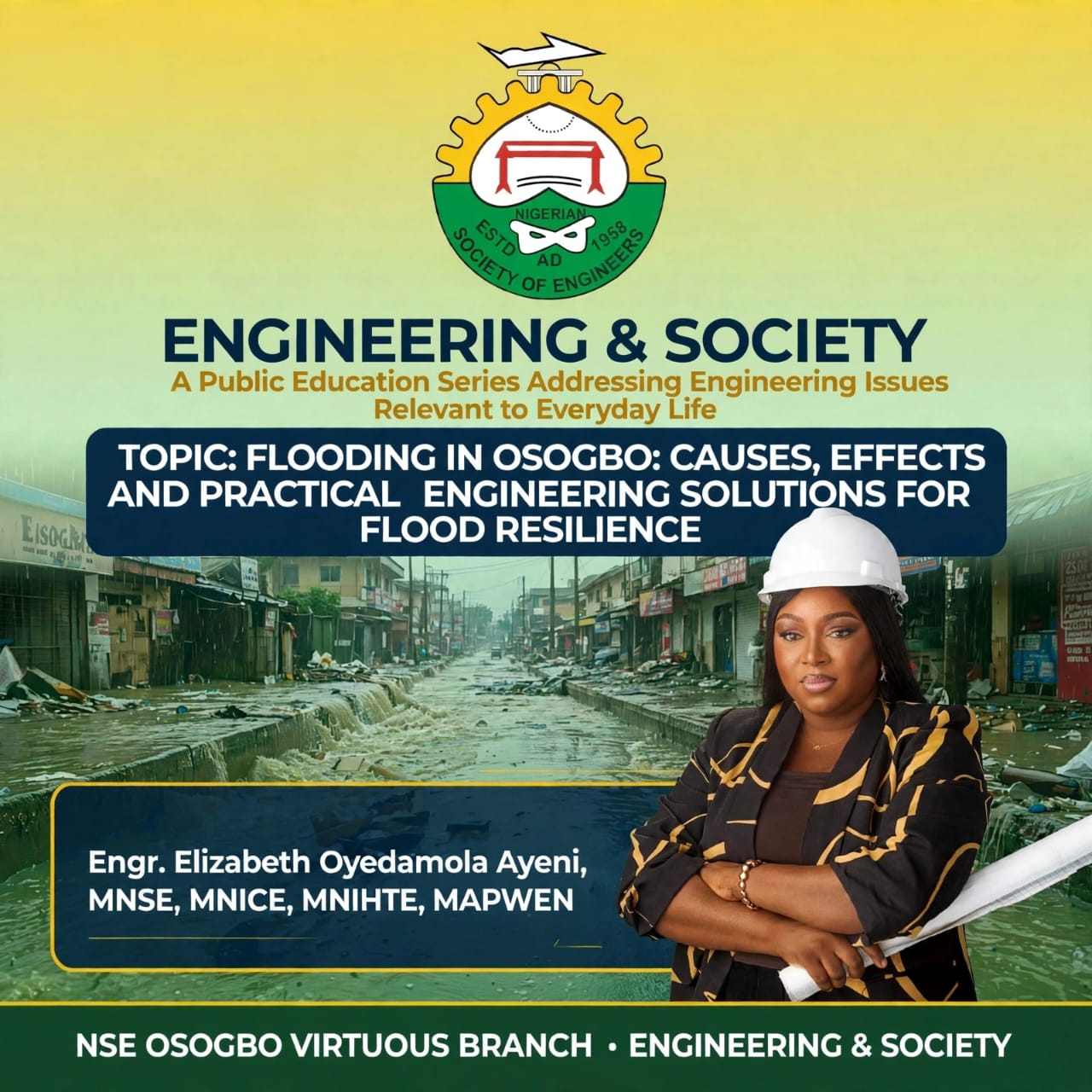
…Engr. Elizabeth Ayeni urges residents to protect drainage channels, preserve wetlands and adopt responsible environmental practices to curb flooding.
A civil engineering expert, Engr. Elizabeth Oyedamola Ayeni, has cautioned residents of Osogbo and neighbouring communities against indiscriminate waste disposal and the construction of buildings on riverbanks and waterways without appropriate approval and professional guidance.
Ayeni, Chairman of the Nigerian Institution of Civil Engineers (NICE), Osun State Chapter, gave the warning while featuring on Engineering & Society, the monthly public enlightenment programme of the Nigerian Society of Engineers (NSE), Osogbo Branch.

The programme is designed to educate the public on engineering issues that affect everyday life, particularly those relating to public safety, infrastructure and community development.
Speaking on the causes and dangers of flooding, Ayeni described it as a recurring challenge in Nigeria, explaining that although heavy rainfall and changing climatic conditions contribute to flooding, human activities often worsen its impact.
She recalled the devastating 2022 floods, which affected several states, including Delta, Bayelsa, Kogi, Nasarawa and Jigawa, leaving behind damaged infrastructure, destroyed property and loss of lives.
Citing figures attributed to the National Bureau of Statistics, she said 64.1 per cent of households across the surveyed states were affected by flooding. Bayelsa and Jigawa reportedly recorded some of the highest impact rates, at 99.3 per cent and 93.5 per cent respectively.
Ayeni also referenced UNICEF figures indicating that approximately 3.2 million people were affected by the 2022 floods nationwide, with children accounting for an estimated 60 per cent of those affected. The disaster reportedly claimed 612 lives.
She explained that flooding occurs when water spreads onto land that is ordinarily dry. Beyond natural causes, she identified poor drainage systems, blocked waterways, indiscriminate refuse disposal, deforestation and unapproved construction along riverbanks as major factors responsible for worsening flood conditions.
According to her, the problem becomes more severe when buildings are erected without proper planning or the involvement of competent professionals who understand the technical and environmental requirements of construction.
Recent Flooding Raises Concern in Osun
The engineer also drew attention to the recent flooding that affected Osogbo, Ikire and Ilesa, describing its consequences as a reminder of the need for more effective flood prevention measures across the state.
She noted that the incidents caused damage to infrastructure and public utilities, displaced residents, destroyed property and farm produce, disrupted businesses and raised concerns about water contamination.
Ayeni warned that contaminated water could expose residents to waterborne illnesses such as cholera and typhoid, stressing that flooding should not be treated solely as an environmental challenge but also as a public health concern.
She described flood resilience as the ability of communities to prepare for, withstand and recover from the effects of flooding. Achieving this, she said, requires proper infrastructure, effective urban planning and the cooperation of residents.
While acknowledging that excessive rainfall cannot always be avoided, Ayeni maintained that its effects can be significantly reduced through better building designs and responsible environmental management.
She recommended directing rainwater from rooftops onto lawns or into collection barrels, while encouraging the use of grass and other permeable surfaces instead of concrete for driveways and open spaces. Such measures, she explained, would allow more water to soak into the ground rather than flow directly into drainage channels.
She also called for regular dredging of waterways to remove accumulated sand and debris, alongside the protection of natural wetlands that provide spaces for excess water to collect. She warned against converting such environmentally important areas into residential estates.
On waste management, Ayeni urged residents to stop dumping plastics, household refuse and other materials into canals, streams and drainage channels, noting that blocked waterways prevent the free movement of water and increase the likelihood of flooding.
She advised communities to clear their drainage channels of sand and debris before the rainy season. Where drainage systems are inadequate or completely absent, she said, the relevant authorities should construct new channels or upgrade existing ones to accommodate large volumes of runoff.
Ayeni further urged urban and regional planners to design residential layouts that respect natural water pathways and discourage informal settlements in flood-prone locations.
She added that properly designed and maintained dams could help regulate overflowing rivers where appropriate, while reforestation would reduce surface runoff and soil degradation.
The engineer encouraged residents and relevant authorities to plant more trees and ensure that trees felled for commercial purposes are replaced.
Ayeni, MNSE, MNICE, emphasised that these measures would only produce lasting results if environmental regulations and anti-flooding policies were consistently enforced.
She commended the Osun State Government for its public sensitisation efforts and steps to penalise environmental offenders, describing such interventions as important in reducing the risks associated with flooding.
However, she stressed that government action alone would not solve the problem without responsible participation from the public.
She urged residents to recognise that keeping waterways clear, disposing of waste properly and respecting approved building regulations are collective obligations.
Ayeni concluded that flood prevention requires a partnership between government, engineering professionals, urban planners and local communities. While the government must provide adequate infrastructure and enforce environmental standards, residents must also adopt habits that protect their surroundings.
She said sustained cooperation among all stakeholders would help create a cleaner, safer and more flood-resilient Osun State.
Issued by:
Engr. Muslihudeen Olayinka Ibrahim, MNSE
Publicity Secretary
Nigerian Society of Engineers (NSE), Osogbo Branch
For:
Engr. Asimiyu Amobi Oyediran, MNSE, FNICE
Chairman
Nigerian Society of Engineers (NSE), Osogbo Branch