
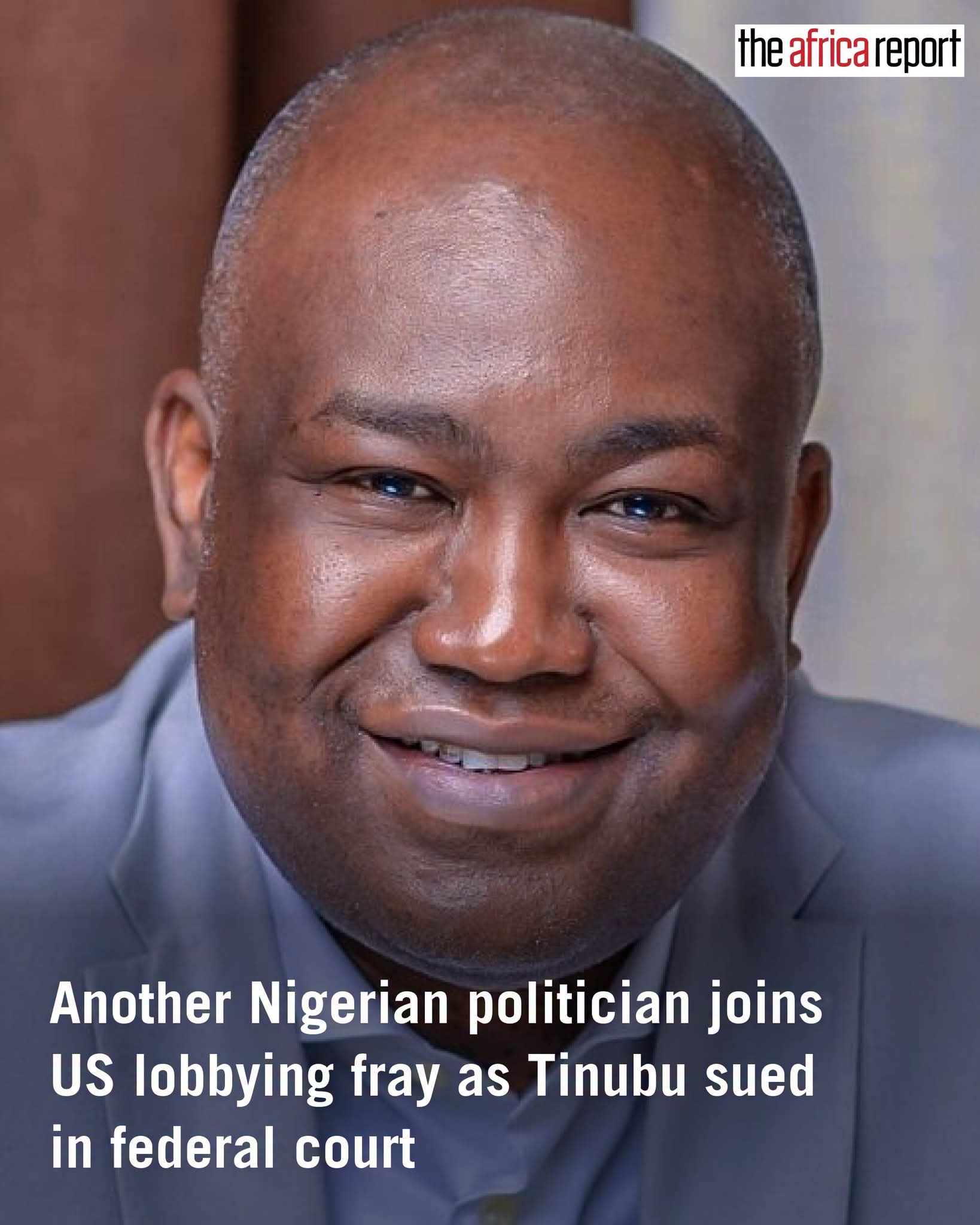
…Accord presidential candidate pursues Africa-led strategy spanning four continents, with focus on Nigeria’s security, democracy and international relations
As political competition intensifies ahead of Nigeria’s 2027 presidential election, Accord Party candidate Dr. Gbenga Olawepo-Hashim is pursuing an international lobbying strategy that stretches beyond Washington, with reported engagements across Africa, the Middle East, Europe and the United States.
The initiative, according to sources familiar with the arrangement, is designed to raise Nigeria’s profile in international policy discussions, particularly on security cooperation, democratic governance, trade and regional stability. It also provides Hashim with an avenue to present his views on Nigeria’s political future to influential international stakeholders.

The growing contest for influence in Washington has attracted attention following reports that Nigerian political actors and government-linked interests have committed millions of dollars to lobbying and public relations activities in the United States. Reports have put total Nigerian-linked spending on such efforts above $11 million.
The development comes amid heightened scrutiny of Nigeria’s international relations and political climate ahead of the next general election. Against this backdrop, Hashim’s approach appears to differ from the strategy reportedly adopted by the ruling All Progressives Congress (APC), which engaged US-based DCI Group in a reported $9 million contract linked to international relations and public image management.
Rather than placing an American firm at the centre of his operation, Hashim is reportedly using an African-based policy organisation to coordinate the broader strategy, with a US government-relations firm handling engagement in Washington.
An African-led strategy with a global reach
At the centre of the arrangement is the Regional Centre for Governance & Security Policy Initiative, a policy think tank based in Freetown, Sierra Leone. The organisation, according to information provided about the engagement, is led by Ambassador Jonathan Sandy, a former ECOWAS diplomat who served as national security adviser and chief of staff to former Sierra Leonean President Tejan Kabbah.
The Washington component has been assigned to Moran Global Strategies, a government-relations firm led by former Democratic US Congressman Jim Moran. Publicly available foreign-agent registration information also identifies Dr. Gbenga Olawepo-Hashim as a foreign principal represented by the firm.
Under the reported structure, the Freetown-based centre provides policy direction and strategic advice, while Moran Global Strategies facilitates engagement with US lawmakers, executive-branch officials and other relevant policy stakeholders.
The issues expected to feature in those discussions include democratic governance, counterterrorism cooperation, trade and stability across West Africa.
A source familiar with the operation said the choice of an African-based organisation was deliberate, reflecting an effort to place African perspectives at the heart of the engagement rather than treating Washington as the sole focus.
“This can be seen in his choice of lobby firm, which is an African-based think tank with pan-African credentials,” the source said, adding that the American engagement formed only one part of a wider international effort to present Nigeria’s interests to global decision-makers.
The reported lobbying strategy did not begin with the Washington engagement. In 2025, Hashim also retained Ashford Advisory, led by British strategist Francis Higgins, for international-relations advisory work involving engagement with Gulf states and Europe, according to information about the arrangement.
The resulting network reportedly links Freetown as an African policy hub, Doha for Middle Eastern and Gulf outreach, London for European strategic advice, and Washington for engagement with US policymakers.
Although the arrangement has been described as a four-continent operation, the extent of coordination among the different locations and the precise scope of each engagement would require further documentary confirmation.
Court ruling strengthens Hashim’s domestic position
Hashim’s international outreach comes against the background of a prolonged leadership dispute within Accord Party over its presidential ticket. The disagreement has raised questions about the party’s internal unity and its readiness to challenge President Bola Tinubu and the APC in 2027.
On October 5, 2026, the Federal High Court in Abuja ruled in Hashim’s favour, directing Accord Party to recognise him as its presidential candidate and submit his name to the Independent National Electoral Commission (INEC). The court also directed INEC to accept and recognise his nomination upon submission.
The ruling marked a significant development in the dispute over the party’s presidential ticket and strengthened Hashim’s legal position in the run-up to the election.
People familiar with his international strategy say the lobbying initiative is intended to ensure that opposition perspectives on Nigeria’s democratic and security challenges receive attention abroad. However, the engagement should not be interpreted as evidence that foreign governments have endorsed his candidacy.
Security diplomacy takes centre stage
Two major objectives reportedly underpin the Washington engagement: promoting stronger international cooperation on Nigeria’s security challenges and encouraging sustained attention to the credibility of the 2027 elections.
Hashim has repeatedly criticised the Tinubu administration’s handling of national security. His position on US counterterrorism operations in northern Nigeria has centred on concerns about Nigeria’s security capacity and the need for a more effective domestic and international response to terrorism.
The argument builds on his longstanding advocacy for closer defence cooperation with friendly countries. In 2021, Hashim called on Nigeria to pursue a Defence Cooperation Agreement that could improve access to intelligence-sharing arrangements, advanced surveillance technology and counterterrorism expertise.
Through engagement with US lawmakers, the State Department and specialists on African affairs, his team reportedly hopes to present Hashim as a potential partner in discussions about West African security, the Sahel crisis and regional stability.
The broader objective is to place Nigeria’s security challenges within a wider regional context, recognising that instability in one country can have consequences for neighbouring states, trade routes and international counterterrorism efforts.
Push for credible elections in 2027
Beyond security, the reported lobbying effort is also focused on Nigeria’s democratic process.
Hashim’s team is seeking communication channels with US policymakers through which concerns about democratic governance, electoral transparency and political competition can be discussed ahead of the 2027 presidential election.
The stated objective is to encourage international support for free, fair and transparent elections, regardless of who ultimately wins.
For the strategy’s proponents, credible elections are not merely a domestic political concern. They argue that Nigeria’s democratic stability has implications for West Africa, where political tensions, insecurity and contested transitions can affect regional cooperation.
Whether the engagement results in concrete diplomatic pressure or policy changes will depend on the response of US officials and developments within Nigeria. Nevertheless, the reported strategy reflects an attempt to ensure that electoral integrity remains part of international discussions about the country.
Hashim’s economic and international profile
Hashim brings a combination of political activism, business experience and international engagement to the presidential race. A former student activist who later became a businessman, he has interests in the energy sector across Europe, America and Africa.
He also received the Lord Max Beloff Prize in Global Affairs from the University of Buckingham in the United Kingdom in 2009, a distinction cited in accounts of his international policy background.
His economic proposals have also featured in his political messaging. A $4 trillion economic revival plan first published in 2018, with an emphasis on industrialisation and job creation, has resurfaced amid Nigeria’s continuing economic challenges.
The plan forms part of Hashim’s broader argument that Nigeria needs a stronger production base, expanded employment opportunities and a more strategic approach to economic development.
His international engagement appears intended to connect these domestic priorities with wider discussions on trade, investment, security and democratic institutions.
Beyond the presidential contest
The growing competition for influence in Washington has often been presented as a struggle by Nigerian political actors to win American favour before the 2027 election. Hashim’s reported approach seeks to frame the exercise more broadly—as an effort to place Nigeria’s long-term interests on the international agenda.
The argument behind the strategy is that Nigeria’s next election will have implications beyond its borders. A credible electoral process, its proponents contend, could strengthen public confidence in democratic institutions and support regional stability. A disputed or poorly managed election, by contrast, could deepen political tensions and complicate security cooperation across West Africa.
That makes the country’s democratic future an issue of interest not only to Nigerians but also to international partners concerned about terrorism, regional trade and stability in the Sahel.
For Hashim, the reported four-continent lobbying network offers a way to communicate that message through African policy channels while engaging decision-makers in the Middle East, Europe and the United States.
Whether the strategy ultimately influences international policy or Nigeria’s political debate remains to be seen. Its significance, however, lies in the attempt to connect the 2027 election with broader questions about national security, democratic governance and Nigeria’s place in the world.
The message Hashim’s team wants international stakeholders to consider is clear: Nigeria’s future should not be viewed solely through the lens of its presidential contest, but also through the consequences that the country’s political and security choices may have for the wider region.