
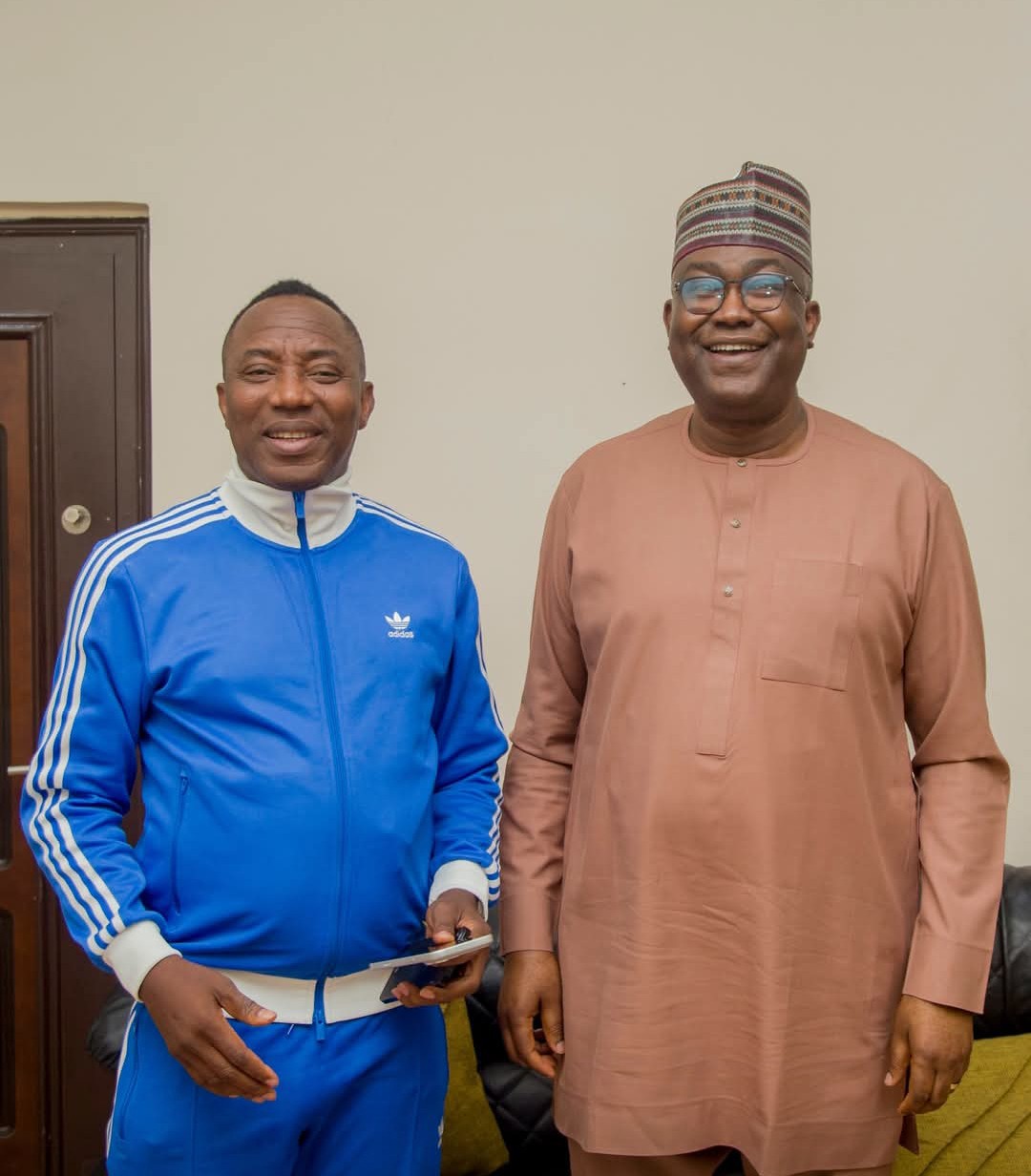
Human rights activist and former presidential candidate, Omoyele Sowore, has paid glowing tribute to Dr. Gbenga Olawepo-Hashim, describing a recent meeting with him as a powerful reminder of the formative moments that shaped his political consciousness during their student days at the University of Lagos.
Reflecting on his early years at UNILAG, Sowore recalled his initial gravitation toward ideological student activism and his encounter with Damian A. Ugwu, a discreet but strategic organiser within the radical student movement at Henry Carr Hall. Ugwu, impressed by Sowore’s resolve as a freshman, facilitated an introduction to Olawepo-Hashim, who was then serving as Public Relations Officer of the National Association of Nigerian Students (NANS).
At the time, Olawepo-Hashim had already faced arrest and detention for his role in the 1989 anti Structural Adjustment Programme (SAP) protests. Following their meeting, he ensured Sowore’s immersion in rigorous ideological training sessions held discreetly at Henry Carr Hall, where activists were exposed to the Thomas Sankara Movement. According to Sowore, these engagements proved pivotal, fundamentally redirecting his political trajectory and eventually leading to his emergence as Welfare Secretary of Henry Carr Hall.

Sowore recounted how repression followed their activism. Olawepo-Hashim, despite completing his studies, was sanctioned by the university for supporting fellow activists, while Sowore and others were later expelled in 1992 for opposing the Babangida military regime. He disclosed that Olawepo-Hashim later revealed his BSc certificate in Mass Communication was seized by the university for five years, a penalty that significantly disrupted his career path before he transitioned from human rights advocacy into business.
Drawing parallels with his own experience, Sowore lamented what he described as a recurring pattern of institutional punishment against voices of conscience in Nigeria. He noted that his academic records were withheld for years, his National Youth Service discharge certificate confiscated, and his international passport seized once again in January.
Despite these setbacks, Sowore emphasized that their shared history underscores a deeper truth about Nigeria’s political environment where principled resistance is often penalised, yet moral conviction endures. He concluded that the memories of their early struggles remain a lasting testament to the power of an awakened conscience, which repression has consistently failed to extinguish.