
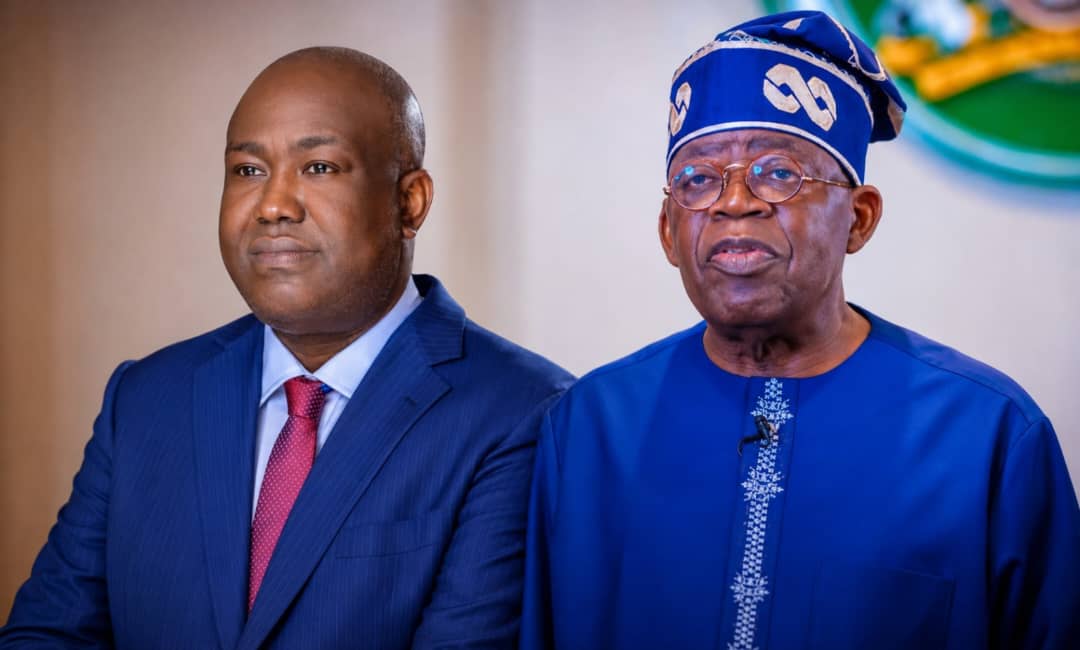
…Accord candidate Claims more than 30,000 lives lost to terrorism under current administration
…Proposes National Guard as part of wider security restructuring
Presidential candidate of the Accord Party, Dr. Gbenga Olawepo-Hashim, has described President Bola Ahmed Tinubu as a “national security risk”, warning that Nigeria could face the emergence of an ISIS-linked terrorist enclave if the President returns to office in 2027.

Hashim made the statement during an interview with Seun Okinbaloye on the Mic On programme, where he expressed concern over the spread of terrorism and banditry across parts of northern Nigeria.
The Accord candidate claimed that more than 30,000 Nigerians had lost their lives to terrorism under the Tinubu administration. He also alleged that armed groups had expanded their influence across rural communities in 17 of the 19 northern states.
Hashim further claimed that terrorists and bandits were beginning to perform functions associated with government in some affected communities, including collecting taxes from residents.
He argued that the development had moved beyond a conventional security challenge, warning that the continued loss of state control could have implications for Nigeria’s territorial integrity and sovereignty.
“Nigeria is at risk of falling into the hands of ISIS if Tinubu returns to office,” Hashim warned.
His latest comments follow a series of interventions in which he has called for urgent action against insecurity rather than waiting for the 2027 election. In June 2026, he similarly argued that insecurity could not be postponed until the next electoral cycle and called for immediate intervention.
Hashim said his proposed response would include a fundamental restructuring of Nigeria’s internal security architecture, with the establishment of a National Guard to confront insurgency and other major internal security threats.
The Accord candidate has previously advocated the creation of such a force, describing it as an institution that could operate between the conventional military and the police and provide a stronger response to serious internal security challenges.
He said the proposed National Guard would be part of a broader strategy aimed at reclaiming territories where armed groups have established influence, protecting vulnerable communities and restoring citizens’ confidence in the Nigerian state.
Hashim maintained that the security crisis should not be measured only by the number of terrorists security forces are able to neutralise. In his view, a more fundamental question is whether the Nigerian government retains effective control over every part of the country.
He alleged that armed groups were attempting to create alternative centres of authority by exploiting communities where government presence had weakened.
The Accord candidate also raised concerns about the reported collection of taxes by armed groups, arguing that such activities could indicate a dangerous shift from ordinary criminal activity towards territorial control.
Hashim has previously made similarly stark assessments of Nigeria’s security situation. In a February 2026 interview published by Vanguard, he alleged that terrorist groups were seeking to establish an extremist enclave and claimed that some communities were already experiencing forms of parallel authority. Those claims were part of his broader argument that Nigeria was facing an unusually severe security crisis.
The Federal Government, meanwhile, has continued to maintain that security agencies are conducting operations against terrorism, banditry and other violent crimes across the country. In August 2026, President Tinubu also directed the preparation of a comprehensive National Threat Assessment and a rolling five-year Strategic Defence Operations Plan to improve coordination among Nigeria’s defence, intelligence and security institutions.
Hashim, however, argued that the government needs to adopt what he considers a fundamentally different approach to the crisis.
He said Nigeria could not afford a situation in which armed groups gradually transformed themselves from criminal organisations into alternative centres of power within communities.
According to him, restoring effective state authority would require stronger intelligence gathering, improved coordination among security agencies, protection for rural communities and a security structure capable of responding quickly to emerging threats.
He further warned that the consequences of losing control of vulnerable territories could extend beyond individual attacks, potentially affecting national sovereignty and the confidence of citizens in government institutions.
For Hashim, therefore, national security should be one of the central issues in the 2027 presidential contest.
He argued that Nigerians would ultimately be deciding not only who governs the country, but also what kind of security architecture should be put in place to protect lives, communities and Nigeria’s territorial integrity.
The Accord candidate’s position places insecurity at the heart of his 2027 campaign message, even as he continues to argue that the government must take immediate steps to address the crisis rather than wait for the next election.